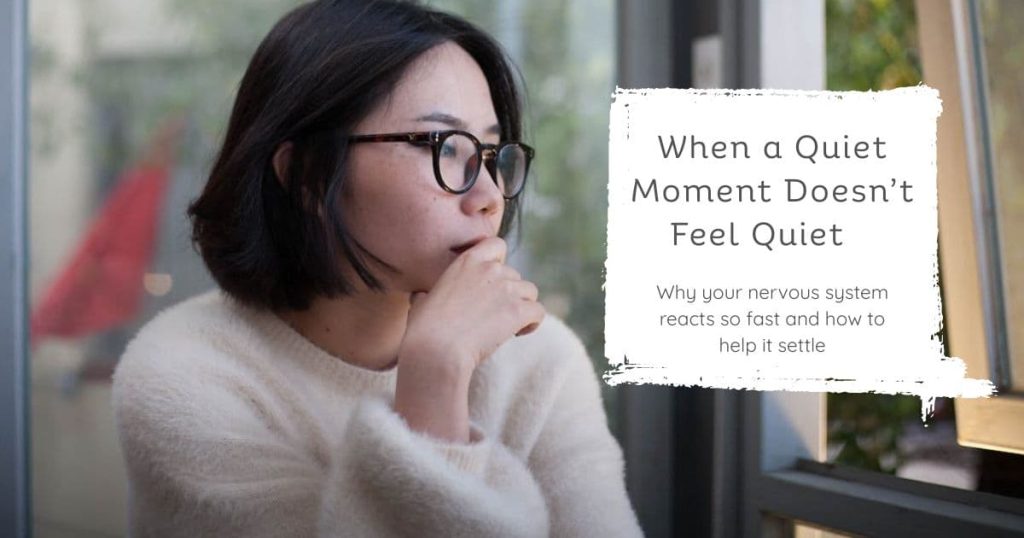
When Your Nervous System Turns a Quiet Moment Into an Emergency
A lot of fear responses begin in moments that look completely harmless from the outside. You put a new cream on a mark on your leg. Not a cheap one. Something you chose carefully because you wanted to treat an old bit of discolouration properly this time.
You are not expecting anything dramatic. Then, out of nowhere, your mind jumps. A tiny sensation. A flicker of awareness in your chest. And suddenly you are off. Is this affecting my heart. Could this clash with my medication. What if this is the start of something.
The sensible part of you is still there, quietly saying it is probably fine. But it is drowned out by the part of you that has lived through enough to not trust “fine” anymore. Your chest tightens. You start scanning your body for clues. And the more you scan, the more your system ramps up. It is rarely about the cream. It is about the time something did go wrong. Or the condition that sits in the background and means your body never feels like neutral ground. Or the years of moments where things genuinely were frightening and your nervous system learned to treat uncertainty as danger.
If any of that feels familiar, you are not alone in it.
It is not you being dramatic
What is happening in that moment is a fear response. Not a phobia. Not a meltdown. Not proof that you are “too much”. It is your nervous system doing something it learned to do a long time ago and firing it at the wrong moment.
At some point your system linked certain signals with danger. A sensation. A shift in someone’s tone. A bit of uncertainty. It stored those things away as cues to react to quickly.
Fear creates a physical response, but it does not only show up in genuinely dangerous situations. It can appear in the middle of an exam, or a conversation, or a normal Tuesday afternoon. The system is not broken. It is just tuned too high. Reacting to things that do not need that level of urgency.
And once that pattern is in place, the cues that set it off can widen. You start bracing for things. Avoiding things. Replaying conversations. Lying awake at 3am with a sense that something is wrong even though you cannot point to anything specific.
This is not the same as a phobia
I work with phobias too and there is a separate page for phobias.
But this is different.
A phobia is a fixed, intense fear of one specific thing, spiders, needles, flying. You know exactly what sets it off.
What I am describing here is looser. A kind of background alertness that follows you around and flares up when you least expect it. If that feels closer to your experience, keep reading.
What it tends to look like day to day
It does not always feel like fear. That is part of why people struggle to name it.
Sometimes it is a physical sensation you find yourself googling at midnight. Sometimes it is a conversation from days ago that your mind keeps circling back to. It is someone coughing nearby and spending the next hour half-convinced you are coming down with something. It is walking into a room and feeling your whole system go on alert for no obvious reason. It is the 3am dread that does not attach itself to anything. It just sits there.
Anxiety and fear can feed each other. Anxiety fuels fear. Fear fuels more anxiety. And the harder you try to reason your way out of it, the more draining it becomes. Because you are trying to have a logical conversation with something that is not operating logically.
This is not a flaw in you. It is simply how these patterns behave.
What actually helps
Fear-Response Hypnotherapy with RTT works differently because it does not stay at the surface. It goes back to where the pattern began.
In a session we find the point where your nervous system first decided this was something to fear. Not to relive it. That is not what this work is. It is more about looking at it clearly and helping the part of you that learned this understand that things are different now. That it does not need to stay on such high alert.

RTT works with the root cause rather than only helping you cope. It uses the brain’s ability to form new pathways, so that where your nervous system once reacted urgently, it can begin to find something steadier.
It is not instant for everyone. But for many people it is the first thing that has made a real difference after years of trying other approaches.
If this sounds familiar
You do not need a dramatic story to seek support. You do not need to be at crisis point. If your nervous system is working harder than it needs to and ordinary moments keep feeling like more than they should, that is enough.
A lot of people who come to me have been managing this quietly for a long time. Talking themselves down. Getting on with things. And that takes energy. The work I do goes a little deeper than that, gently and without rushing.
If you would like to talk it through, a discovery call is free, informal and genuinely without pressure. You tell me what is going on, I tell you honestly whether I think I can help, and we go from there. Book your free consultation here
If what you are dealing with is a specific phobia rather than general fear responses, I have a dedicated page for that too.
Find it here – Hypnotherapy for Phobias

Questions people ask me about this work
When your body reacts faster than your mind can make sense of, it can feel confusing and unsettling. These FAQs explain why it happens and how your system can learn to feel safe again.
What is the difference between this and a phobia
A phobia is a fixed, intense fear of one specific thing and you usually know exactly what it is. What I am describing here is broader. A nervous system that has become over-sensitised and reacts to situations, sensations or uncertainty in ways that feel out of proportion. Many people have never had a name for it, which is part of why it goes unaddressed for so long.
How is this different from anxiety hypnotherapy
They do overlap and sometimes people need elements of both. Anxiety work tends to centre on persistent worry, the busy mind, the constant background dread. Fear-response work is more about the automatic reactions, the ones that fire before you have had time to think. If you are not sure which fits your experience better, bring it to the discovery call and we will work it out together.
It feels completely automatic. Can RTT really reach something like that
That automatic quality is exactly why RTT tends to work well here. The response feels instant and uncontrollable because it comes from the subconscious, not the conscious mind. RTT works at that level directly, updating the pattern at the source rather than trying to override it from the surface.
How many sessions does it take
Most people notice real change within one to three sessions. Fear-based responses often link back to specific beliefs formed earlier in life and they tend to respond well to this kind of work. I can give you a clearer sense of what to expect once I know more about your situation, which is what the discovery call is for.
What does a session feel like
You are guided into a deeply relaxed state, similar to the feeling just before sleep. You stay fully aware and in control throughout. We look at where the pattern first formed, work gently with the part of you that has been holding it, and I create a personalised audio recording for you to listen to over the following 28 days. That recording is an important part of how the changes settle in.
I have tried talking therapy before. Why would this be different
Talking therapy works with the conscious mind and can be genuinely helpful for understanding your patterns. But understanding a fear response does not always stop it firing. RTT works with the subconscious, where the response actually lives. Many of my clients have tried other approaches for years and find that this reaches something those did not.
I also have anxiety. Is this still suitable
Fear responses and anxiety often go hand in hand and this work can support both. If you are currently working with a GP or mental health professional, I would always suggest discussing any new therapeutic work with them first. Your discovery call is a good place to raise any questions and work out whether this is the right fit for where you are now.
What happens on a discovery call
It is informal, around 20 to 30 minutes, and completely free. We talk about what you are experiencing, what you have already tried, and what you are hoping for. There is no obligation to book anything afterwards. It is simply a conversation.
Ready to move forward?
Let’s chat about what’s been holding you back and explore how we can shift things together.
Book your free consultation today and take that first step toward positive change.
Fear‑response hypnotherapy to calm an over-alert nervous system, ease automatic reactions and help your body feel safe again. Gentle online RTT sessions to help you feel steadier and more in control.

About the Author
Joanna Jewitt is a Clinical Hypnotherapist and Advanced RTT® Practitioner who specialises in helping thoughtful, high‑functioning people understand and shift the patterns that keep them stuck. Trained personally by Marisa Peer, she blends RTT® hypnotherapy with a calm, collaborative, client‑centred approach. Joanna supports clients across the UK and worldwide through online sessions, helping them build lasting clarity, confidence, and a deeper sense of inner safety.
Related Links
Fear Response Hypnotherapy
– Gentle RTT sessions to calm an over-alert nervous system and help your body feel safe again.
Related Case Studies
Finding Steadiness Again After a Distressing Life Event
– A woman regained steadiness after a distressing event left her spiralling and doubting herself. Gentle RTT work helped her calm her mind and feel like herself again.
From Panic to Peace: Navigating Driving Anxiety with RTT
– An experienced driver rebuilt her confidence and self-trust behind the wheel, moving from avoidance to handling unexpected situations with ease.
Let’s Stay in Touch
Related Blogs
The Inner Critic as a Survival Strategy
– Why self‑criticism often begins as protection, not a flaw.
Anxiety, Brain Fog, and How RTT Restores Clarity
– How anxiety affects focus and mental clarity, and how RTT helps your mind settle so you can think clearly again.
Overcome Stress with Hypnotherapy
– How stress affects the body and mind, and how RTT helps you reconnect with calm and clarity.
Let Go of Replaying Past Events
– Why the mind loops old moments and how RTT helps you break the cycle and feel more grounded.